


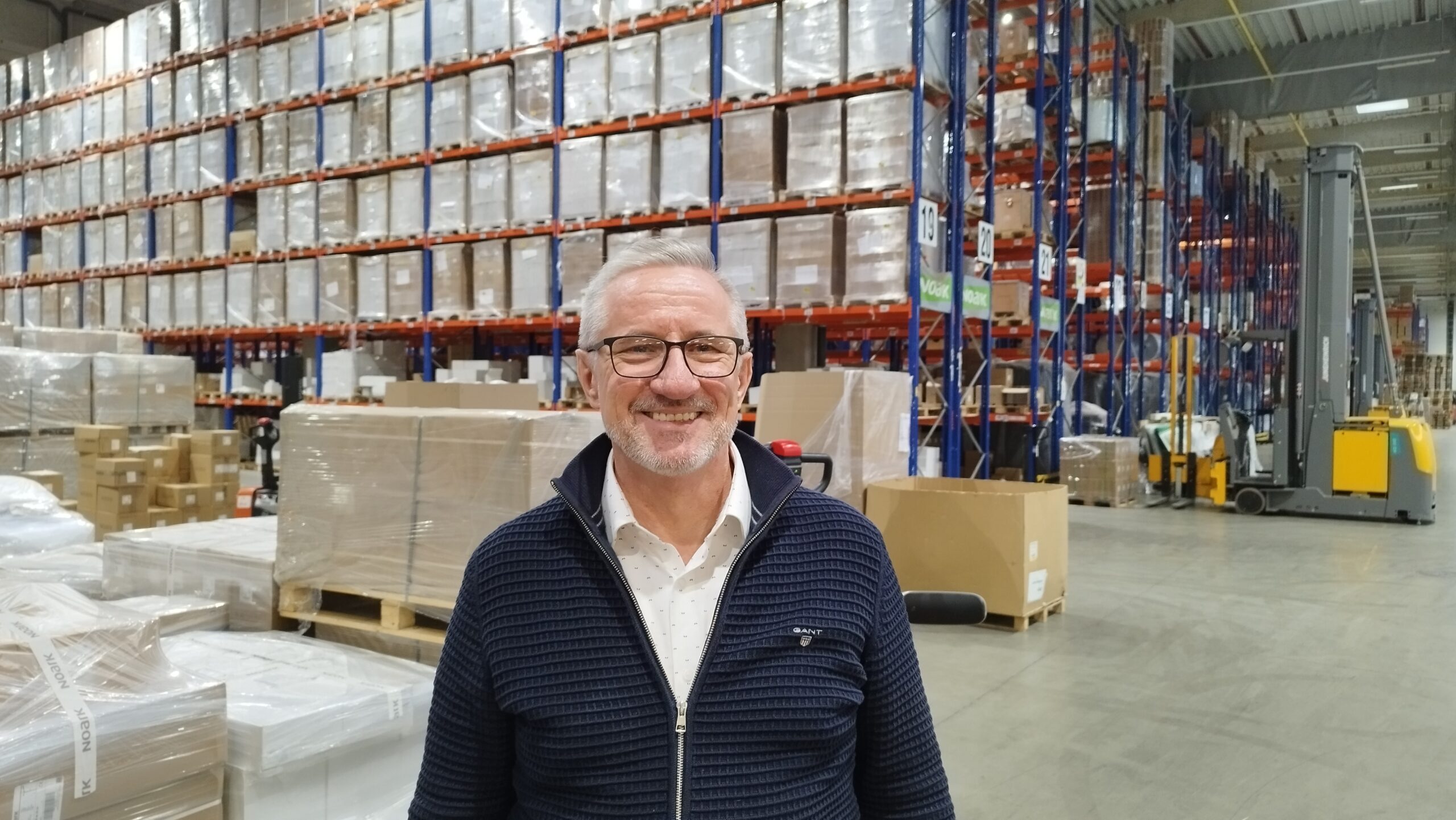
Artificial intelligence is no longer a topic of the distant future in logistics. It is increasingly reflected in everyday practice, whether it is working with data, optimizing processes, predicting workload, or preparing for broader automation of warehouse operations. PST CLC Mitsui-Soko, which is currently monitoring the possibilities of its use in logistics, sees AI as a current topic today and as one of the essential elements that will affect the shape of modern logistics in the coming years.
Currently, PST CLC Mitsui-Soko has so far used artificial intelligence rather indirectly, mainly through third-party tools. These include, for example, demand forecasting, sales analysis or basic route optimization. At the same time, the company works with modern technological elements within the WMS, process optimization and innovation-focused projects. “I see AI as a topic of the moment, but also as a key element of the long-term future of logistics, because automation, prediction and data decision-making will play an increasingly important role. Its practical use will bring quick and concrete results,” says Pavel Nodžák, Logistics General Manager at PST CLC Mitsui-Soko.
As he adds, logistics today operates in an environment of high competition and growing demands on the quality and speed of services. This requires a high level of innovation from major providers of warehousing, customs and transport services. That is why the company monitors the possibilities of AI very intensively and gradually evaluates where it can bring the greatest effect.
In the future, Pavel Nodžák sees the greatest potential primarily in the robotization of warehouse operations and in intelligent WMS. However, he points out that such investments must make economic sense. “However, this requires a long-term contract with the customer in terms of return,” he emphasizes.
According to him, advanced warehouse utilization prediction also opens up great opportunities. In an environment of multiple locations and changing demand, the ability to anticipate future developments can be one of the decisive factors for efficiency. He sees a perspective, for example, in the fact that AI will be able to work with seasonality, weather, marketing campaigns, historical data and other trends. This could be beneficial, for example, for the company’s multiuser warehouses in Úžice, Pohořelice, Brno and Mošnov. Another area is related to this, namely dynamic capacity planning.
According to Pavel Nodžák, AI could estimate in advance when traffic peaks will occur and help adjust shifts, capacities and overall traffic settings. He also sees significant potential in automatic transport management with regard to real traffic data, constraints and costs.
Mitsui-Soko also considers the concept of a digital twin of the warehouse to be very promising. This is not just a theoretical consideration. The company has been using this concept in practice since 2022 at the resort in Kutná Hora. The digital twin helps here in particular in simulating the layout of the warehouse, testing various configurations and optimizing the flow of handling equipment.
“This concept is especially beneficial for us in the areas of warehouse layout simulation, where various configurations can be tested and modified. At the same time, we optimize the flow of material handling equipment, for example by reducing downtime and unnecessary zero load. Thanks to the digital twin, we are better able to coordinate performance and optimize costs,” says Pavel Nodžák.
Working with performance, capacities and human resources is one of the areas where the company’s management expects another significant benefit from AI. PST CLC Mitsui-Soko operates in multiple locations and works with different types of operations and processes. According to Pavel Nodžák, this creates a strong space for the future use of AI, for example, in predictive management of individual and shift performance, in risk identification, in setting up processes or in reducing errors in order preparation.
In the future, AI could also help monitor the quality of work, distribute tasks more fairly according to the current workload, and support work safety. Pavel Nodžák sees the importance of warehouse utilization prediction primarily in the fact that the company would gain better control over future capacity utilization, be able to make faster decisions and at the same time reduce operational risks.
When asked whether AI will have a greater benefit in reducing costs or in increasing performance, Pavel Nodžák answers unequivocally: at the current stage, especially in performance. According to him, more precise planning, fewer errors and more efficient processes are directly reflected in the quality of services provided to customers. In the long run, however, AI will also be essential for reducing costs, both in transport, inventory management and warehouse operations. “Companies that do not adopt AI will have significantly limited competitiveness in the future, especially in logistics, where speed and accuracy are crucial,” says Pavel Nodžák.
According to him, if a company could choose one AI feature that would be implemented immediately, it would be predictive and automated orchestration of warehouse capacities across all locations. In other words, a system that would predict the utilization of individual warehouses in real time, identify free capacities and automatically organize their best use. Such a solution would be of great importance for PST CLC Mitsui-Soko, also with regard to the scope of its own infrastructure. Today, the company has more than 85,000 m² of warehouse space. Smart management and forecasting of the utilization of individual warehouses could therefore significantly increase efficiency, overview of capacities and the possibilities of further development of services, including the currently highly sought-after short-term provision of warehouse space and related logistics services.
According to Pavel Nodžák, the topic of AI will continue to be reflected in the field of robotics. He also considers humanoid robots to be a long-term trend, although this is not yet a common reality in Czech warehouses. However, according to his estimate, the first pilot installations may be seen within the next five to ten years.
“Humanoid robots can completely change the way we work in warehouses, especially where human flexibility is needed in an environment built for people. Safety, reliability and integration with handling equipment and the human factor will be a big topic,” he says.
According to him, the outlook for 2030 is relatively clear. Logistics will be significantly more autonomous, more connected and able to optimize itself in real time. Smart data systems, autonomous planning and decision-making over logistics operations are to become a common part of practice. Manual steering will gradually recede and intelligent and connected automated systems will take on an increasingly important role.
PST CLC Mitsui-Soko thus confirms that AI is no longer just a vision that is discussed at conferences. It is becoming part of the strategic thinking of logistics companies and increasingly a practical tool that can decide on performance, quality of services and future competitiveness.
